What Does This Report Explore?
This report is the second to utilise findings from our Dads Survey 2025, bringing together fresh insights from 440 fathers across Scotland alongside findings from our 2024 Time with Dad Report. Together, these data sets provide one of the most comprehensive pictures to date of what the journey into fatherhood looks like today for Scottish dads.
By exploring how dads navigate their journey and what would make that transition easier, it brings together the challenges they face, where they look for support, and the systemic changes they want to see. Shaped by the voices of dads themselves, these findings highlight the real experiences of new fathers and identify the practical support they need to succeed in their role.
Acknowledgements
Our sincere thanks go to the Scottish Government’s Parenting, Play and Baby Box Team, whose funding made this survey possible; to everyone who contributed to the design and development of this year’s survey, including: Dr. Lisa Golds, Dr. Sarah Foley, Smart Play Network, Shared Parenting Scotland, Flexibility Works, the Scottish Government Children’s Rights Unit, Parenting Across Scotland, Dads Rock and the dads who helped with testing, and to all the dads show have generously responded to our 2024 and 2025 surveys - the backbone to this comprehensive report.

Watch Presentation & Expert Panel Discussion:
Key Findings
 Many of Scotland's infants are being denied the best start in life as a result of the UKs statutory paternity leave, the worst in Europe.
In the UK, dads are entitled to just two weeks of paternity leave, paid at less than half the minimum wage, while self-employed fathers receive no statutory support at all. This offering of statutory paternity leave is among the worst in Europe, falling well behind neighbouring countries in both duration and pay.
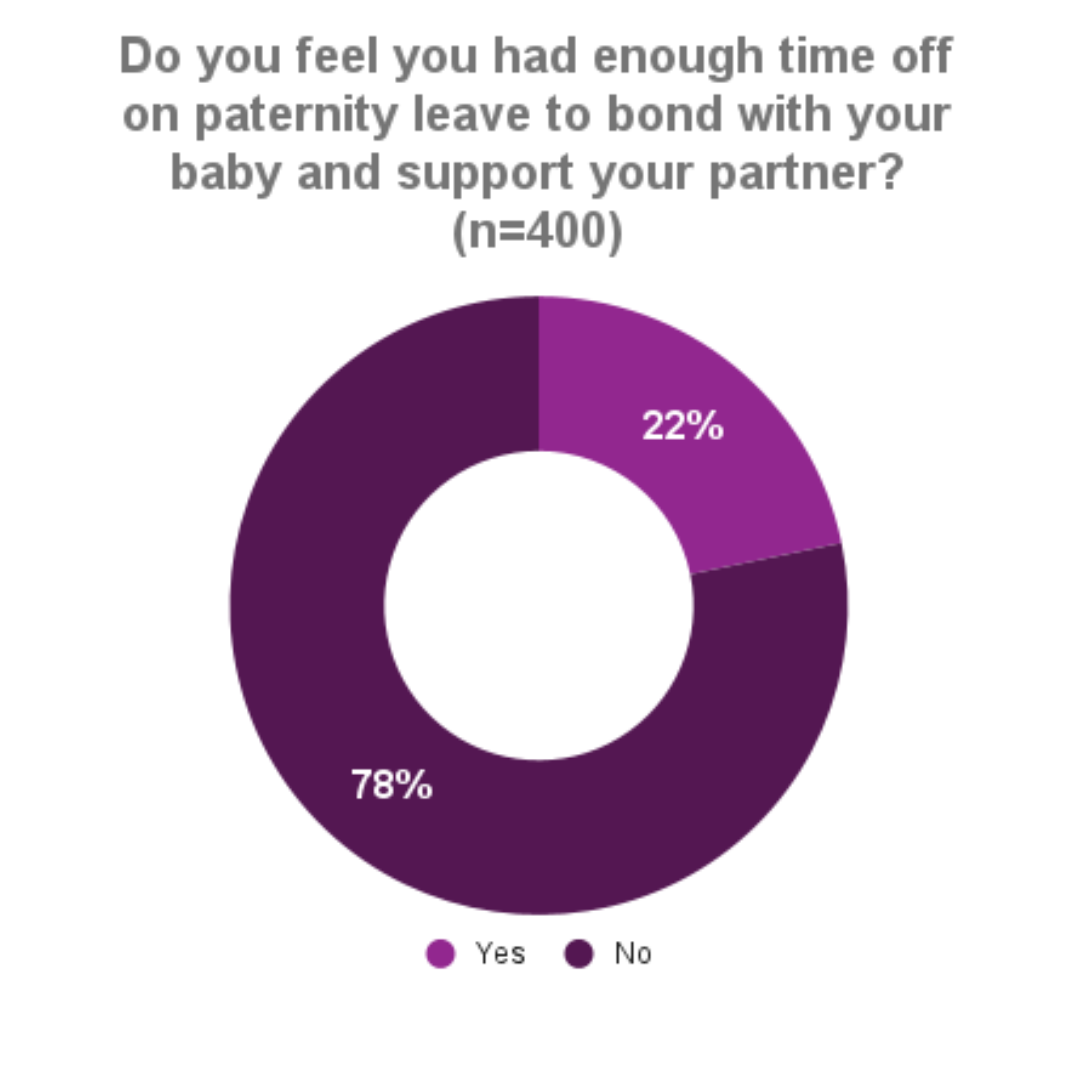
This is reflected in our data, as 75% of dads took two weeks or less of leave (the minimum statutory duration provided), while 78% of dads felt the paternity leave they received did not give them enough time to bond with their baby or support their partner.
Moreover, the data shows a clear correlation: 90% of dads who took the statutory two weeks or less reported not having enough time, compared to only 23% of those who took six weeks or more, highlighting the need for longer leave.
Scottish dads don’t know where to go to access support and information as they transition into fatherhood.
Our research highlights a significant gap in signposting and information available for new fathers.
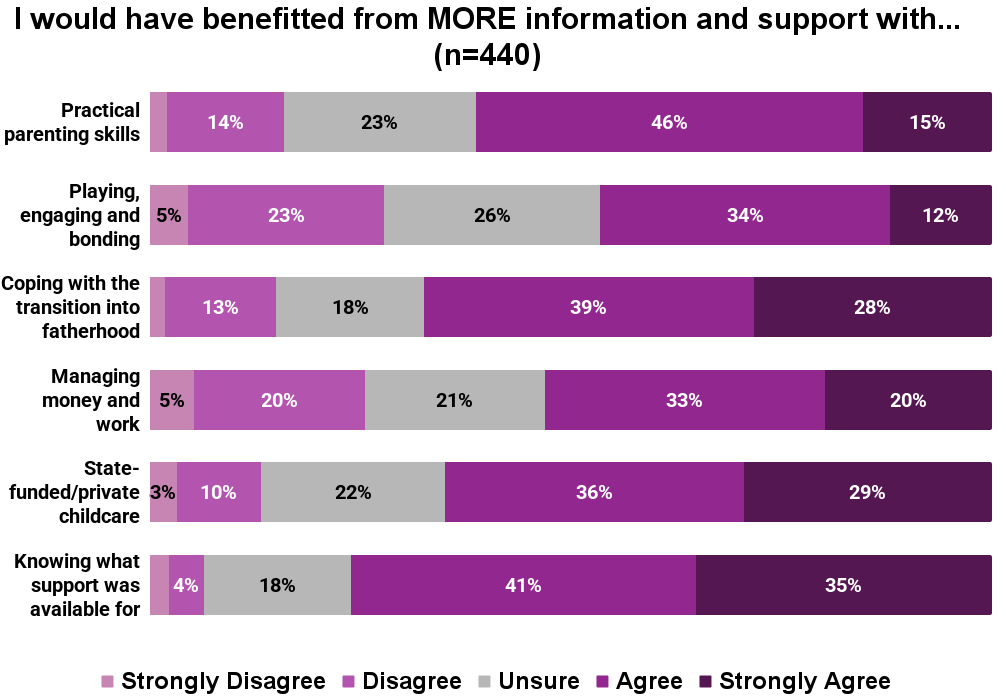 When we asked 439 Scottish fathers what support they wished they’d had as they entered fatherhood, a striking 76% simply wished they had known what support was available.
A clear picture of the lack of information was seen generally as:
- Two-thirds of fathers (67%) felt they lacked the information needed to personally cope with the transition into fatherhood.
- 65% wished they had more information on state-funded/private childcare.
- 61% wished they had more information on how to care for their child.
 Mobile phones frequently interrupt the time dads spend with their infant in the first year.
The debate surrounding screen time and social media is rarely out of the headlines. Usually, the conversation focuses on how children and teenagers interact with and are impacted by technology, but what about the impact of parents' digital habits?
We asked dads how often they were interrupted by their mobile phones, and those who said phone use 'often' or 'very regularly' interrupted their time tended to have the youngest children - who most need active face-to-face connection.
- Under 1s: 31% (nearly one-third) of dads reported frequent interruptions.
- Ages 3-5: 29% reported frequent interruptions.
- Other age groups: Averaged between 15% and 22% (roughly 1 in 5).
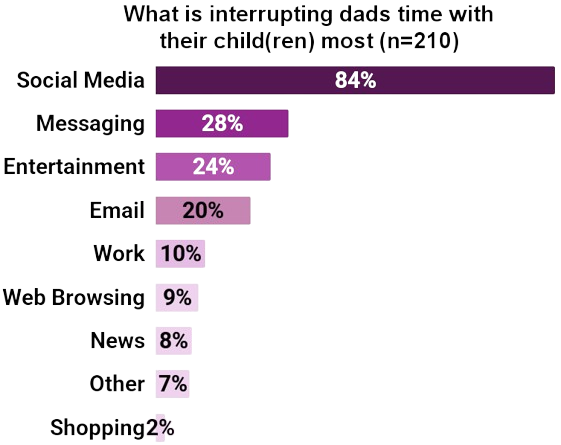
Out of all 430 fathers surveyed, 210 shared more detail about what was pulling them away from their children. Unsurprisingly, social media emerged as the primary source of digital distraction, with 84% of dads reporting that it interrupted their time.
New dads go to their partners first for advice, but often find the most helpful support through friends and family.
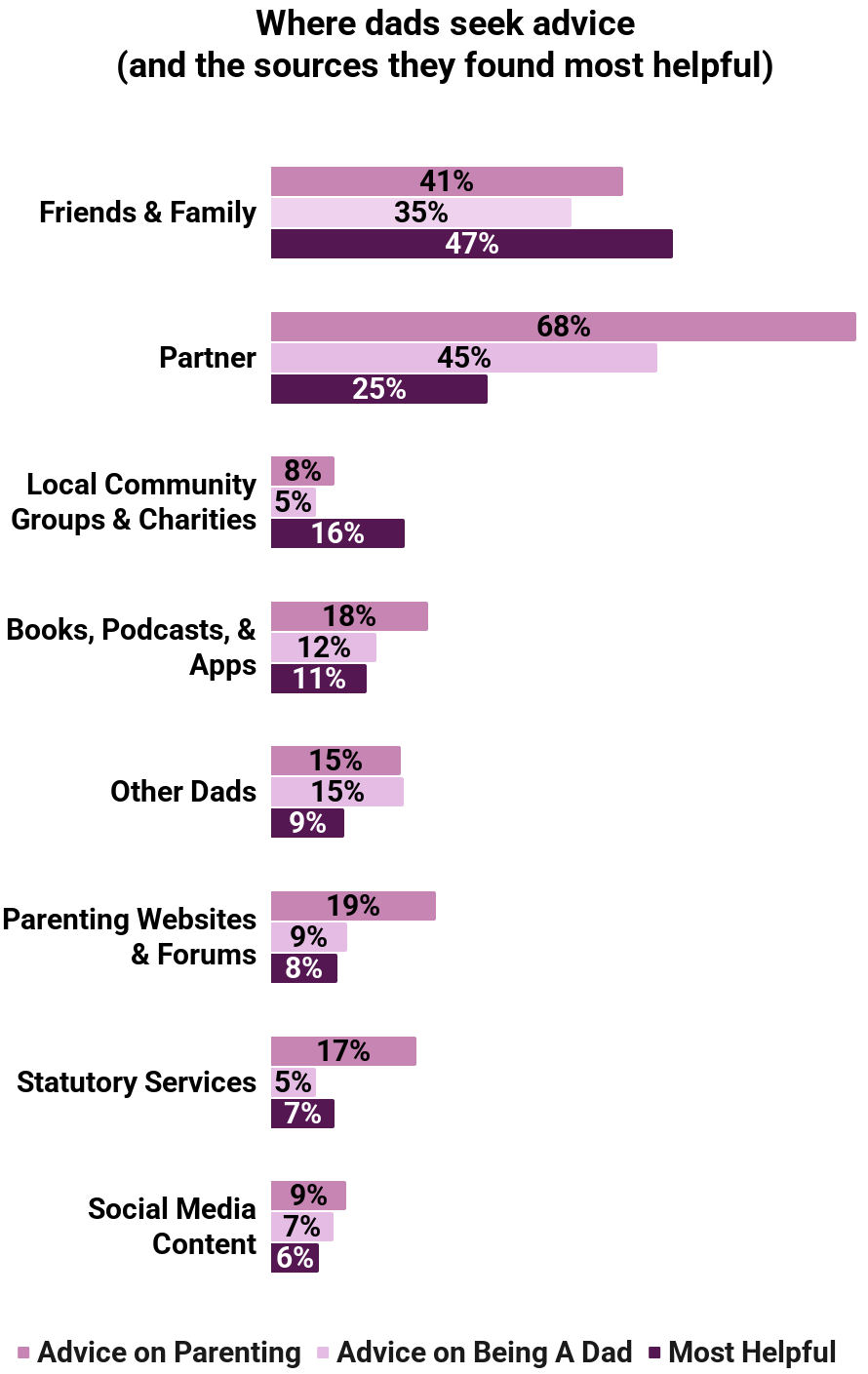 The vast majority of dads (68%) turn to their partner for advice on caring for their newborn. As mum and infant are the focus of care professionals' attention during the perinatal period it is perhaps no surprise that fathers defer to mum for advice.
What is more surprising is that, almost half (45%) of dads turn to their partner for advice and support on how to cope with their transition into fatherhood. This may be because men in their mid-life often depend on their partners as their sole source of emotional support.
Interestingly our findings revealed that less than one-quarter told us that information from mum was the most helpful, suggesting that the information being passed from services through mum may not always be relatable, applicable, or tailored to the father's specific needs.
While these findings don't give us all the answers, they do show that we need to rethink how we support new dads.
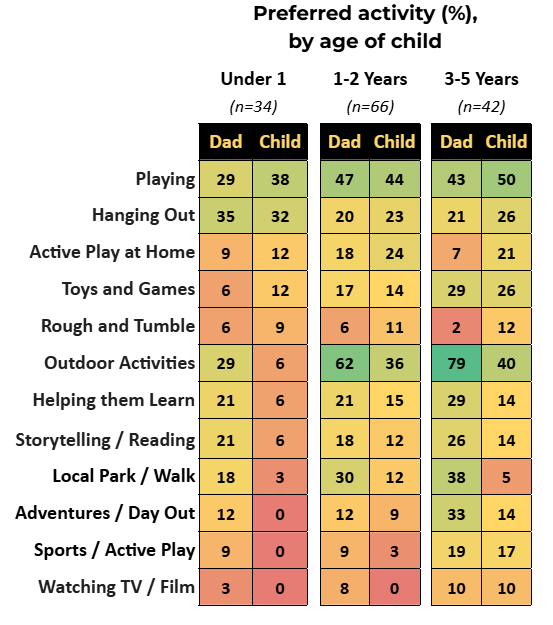
Fathers love spending time playing with their children, particularly outdoors, and helping them learn.
Our 2024 Time with Dad report explored how 400 Scottish fathers prefer spending time with their children, revealing a strong focus on play as 44% of dads identified “playing” as their favourite activity.
Outdoor engagement was especially popular, with 73% of all fathers favouring time spent outside.
New findings show that dads value outdoor time even when their child is under one and that this connection truly comes alive once their little one gets more mobile. At just 1-2 years old, 62% of fathers cite outdoor activities as their preferred way to bond.
Beyond physical play, it’s encouraging to see how much fathers enjoy supporting their child’s cognitive development. Among dads of 1-2-year-olds, 21% say helping their child learn is a favourite activity, with reading and storytelling close behind at 18%.
Relevant Reports From Our Series:
Dads' Survey 2025 Report |
Time with Dad Report |

Background to the Series
The COVID Effect:
Before the Spring 2020 lockdown mothers in couple households in the UK were contributing almost twice as much unpaid childcare as fathers. During the first lockdown we found fathers’ stepping up to do much more hands-on caring of their children - ONS data confirmed what we were seeing - for every hour spent by mum dads were spending 53min. In 2022, as ‘life returned to normal’, we anticipated that dads levels of unpaid childcare would snap back to pre-pandemic proportions. Happily we found this was far from the case, with the ONS once again confirming our survey findings - an 18% increase in fathers unpaid childcare from pre- to post COVID. Lockdown had transformed dads' relationship with their children and sparked a quiet childcare revolution, with more and more fathers wanting to be present and positively involved.
The Impact of a Global Economic Crisis:
As COVID restrictions and regulations eased a global economic crisis was gathering force. The cost of living across the UK began to soar, and in October 2022 inflation hit a 40 year record high of 11.1%. In April 2023 the Scottish Government announced “People all across Scotland are being affected by the most severe economic crisis in a generation”. Our 2023 survey showed that despite the crisis dads were continuing to put their family first, as time spent caring for their children reached a new high. However, dads also told us how difficult they were finding striking a balance between being a provider and caring for their children and the importance of family-friendly work.
For more information about our survey and findings, please contact our director, Cathy Sexton: [email protected]