This report is the seventh in a series charting Scottish fatherhood since the first COVID-19 lockdown, capturing how dads have navigated a time full of unprecedented challenges.
Throughout this period, we have listened closely to Scottish dads from across the country and from diverse backgrounds, exploring how they manage family life, work, and mental health amid ongoing pressures. To date, nearly 3,000 dads have contributed across seven comprehensive surveys.
Between 1-30 June 2025, a total of 440 dads responded to our latest survey, sharing their experiences and perspectives. This report - the first of two based on this cohort - draws on their responses alongside data from 2022 to 2024 to track how dads’ experiences and attitudes have evolved and to highlight emerging trends.
Acknowledgements
Our sincere thanks go to the Scottish Government’s Parenting, Play and Baby Box Team, whose funding made this survey possible; to everyone who contributed to the design and development of this year’s survey, including: Dr. Lisa Golds, Dr. Sarah Foley, Smart Play Network, Shared Parenting Scotland, Flexibility Works, the Scottish Government Children’s Rights Unit, Parenting Across Scotland, to Dads Rock and the dads who helped with testing, and to the 440 fathers who generously responded to this years' survey.
This report is in memory of Calum McNab.

Watch DADx Talk:
Context
Since our last report, the ongoing economic situation has only placed more pressure of families, with the an Understanding Scotland Report in May 2025 stating:
“Economic sentiment has deteriorated further. More people now believe both the general economy and their own financial situation have worsened compared to a year ago, and expectations for the year ahead remain bleak… Crucially, these pressures are not borne equally… households with children are consistently more likely to report serious impacts, from deteriorating mental and physical health to food insecurity and strained relationships.”
However, amid the many difficulties fathers and families are facing, it’s important to recognise the positive shifts that have brought fatherhood into sharper focus than ever before. From the critically acclaimed Netflix drama Adolescence highlighting the stark need for positive father involvement, to heartfelt cornerstone Christmas adverts celebrating the unique bond between dads and their children. Fatherhood has rarely been out of the public eye in the past year as the conversation around modern fatherhood continues to evolve.
National campaigns like the DadStrike have also raised public attention, amplifying dads’ calls for improved paternity leave and a more active, equal role in childcare and family life. While recent research confirms this momentum, revealing that the next generation of fathers aspire not only to share childcare equally but, in many cases, to take on even more responsibility than their partners.
The ‘quiet childcare revolution’ highlighted in our previous surveys appears to be thriving. However, while this revolution signals promising change, the question now is: how do we transform these aspirations into reality given the current socio-economic landscape?
What we Wanted to Find Out
What are dads views on paternity leave? How are dads managing work-life balance better amid prolonged economic pressure? Are dads continuing to share parenting responsibilities more equally? And how is all this impacting their mental health and wellbeing?
 Dads are spending less time engaged in childcare and household chores, suggesting a slide towards traditional gender stereotypes.
Despite the strides dads made connecting with their children during COVID-19 and the years that followed, this year’s data suggests a troubling slide.
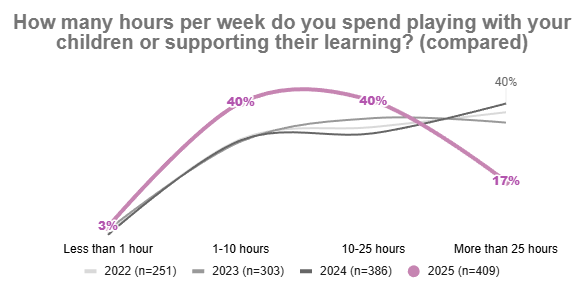
From 2022 to 2024, around 70% of dads spent 10 or more hours a week playing with or supporting their children’s learning.
In 2025, time spent on these activities declined noticeably, with just 57% of dads reporting ten or more hours per week playing with their children or supporting their learning. And only 17% said they spend more than 25 hours weekly, representing a 20% drop compared with the last three-year average.
Dads from the most deprived areas continue to spend the most time but have experienced the biggest drop in involvement (down 29% since 2024).
“My manager is not supportive of me having time off when I need to care for my children."
“I worry about being there for my children… being able to afford the things I want to provide for them.”
This decrease is mirrored in household chores, with only 38% of dads reporting spending five or more hours per week on household chores (a drop of 20% in 2024).
 The vast majority of dads feel they had insufficient paternity leave after the birth of their youngest child.
In 2024, just over half of dads (51%) reported that balancing work and family life was ‘difficult’ or ‘very difficult.’ This year, this figure dropped to 43%. Meanwhile, only 1 in 10 only 1 in 10 dads (9%) describe their work-life balance as ‘easy’ or ‘very easy’.
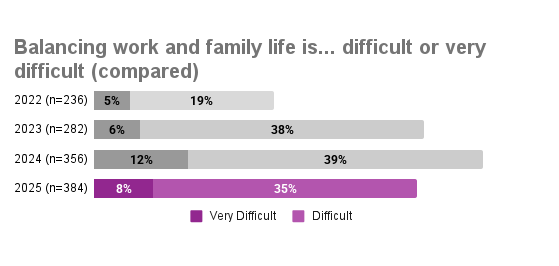 Although the data indicates a decline in dads reporting difficulties, the figures remain broadly in line with 2023 (44%), suggesting that last year’s increase may have been a temporary spike. Nevertheless, the reality remains that over two in five dads continue to experience difficulty balancing work and family life.
“As a man [a flexible working request] would be unlikely to be accepted for childcare purposes.”
Among the 440 survey responses, three-quarters (75%) of dads reported taking two weeks or less of paternity leave.
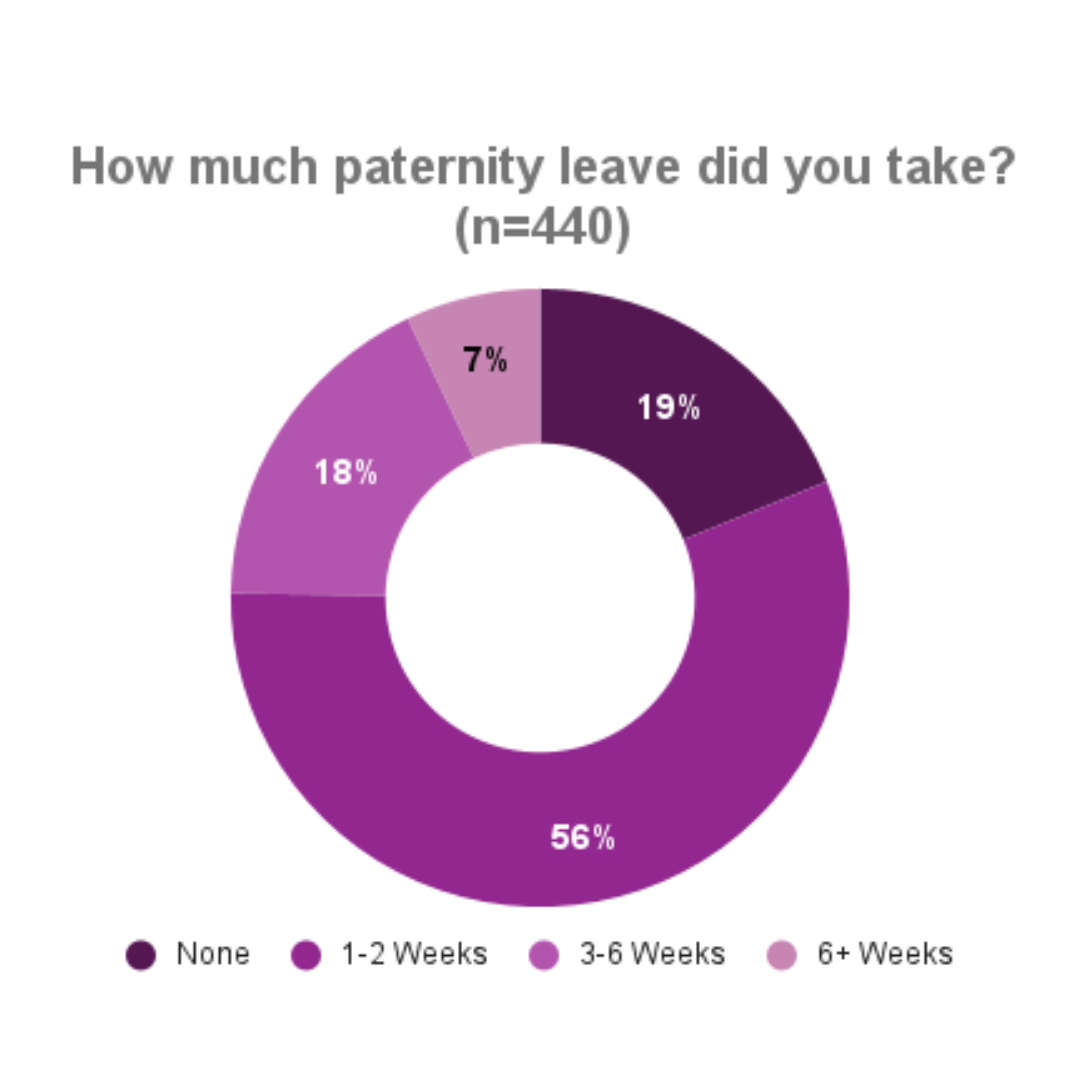
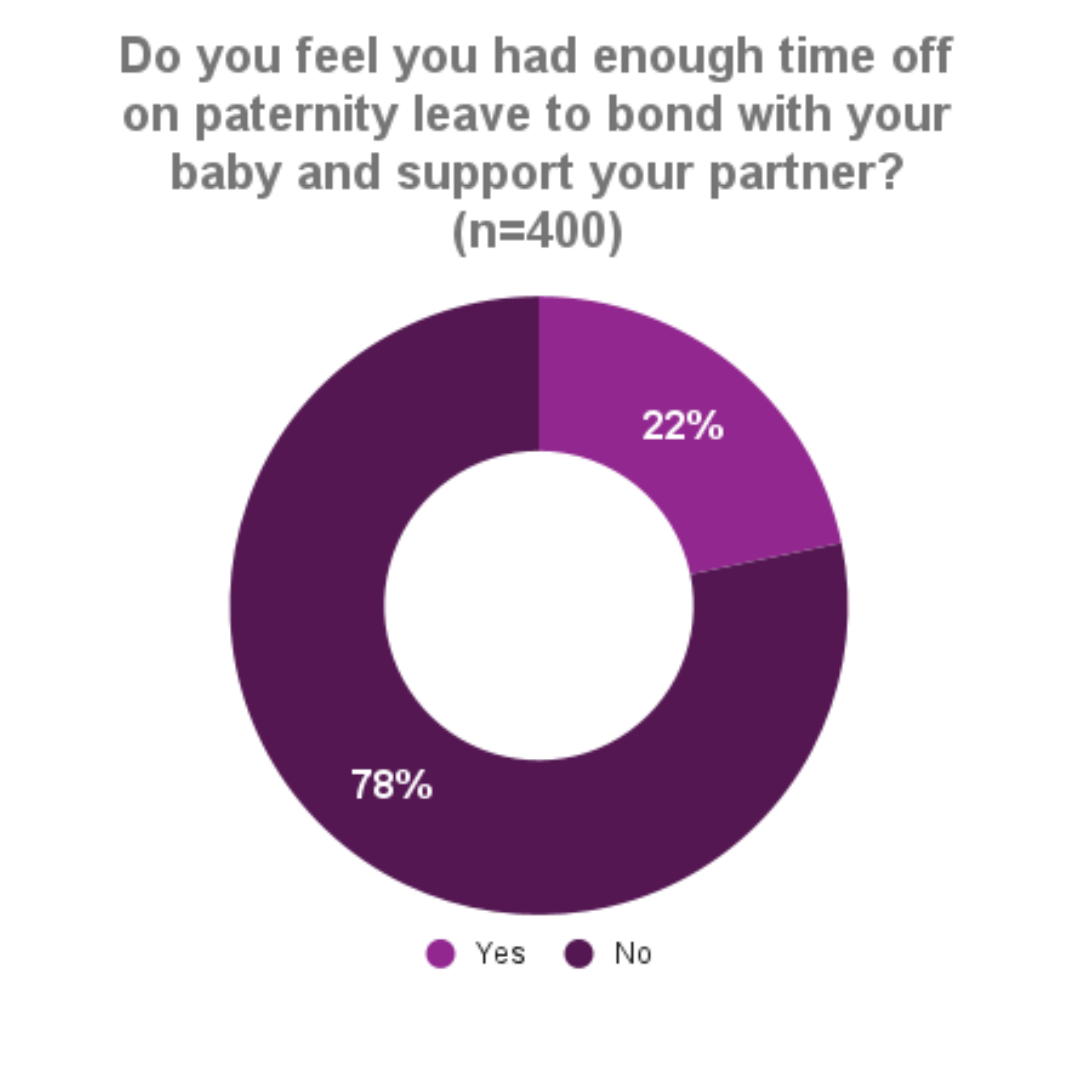
However, a striking 78% of dads said their paternity leave fell short of what was needed to bond and support their family.
This rises to 90% for dads who could only take 1-2 weeks paternity leave.
"We had premature twins, my wife was recovering from a C-section, and we had almost no family help. I needed more time but didn’t get any.”
“I would always have liked more time, but I needed to work for money.”
 Poor mental health continues to affect dads, particularly those living in deprived areas or separately from their child(ren) some or all of the time.
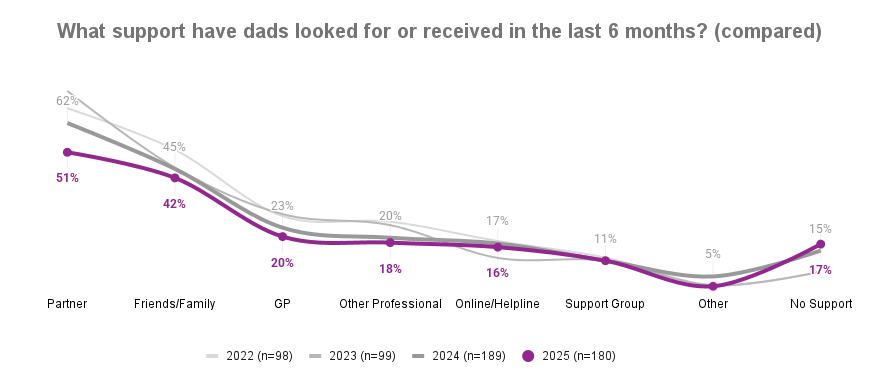
And fewer than ever are looking for or receiving support.
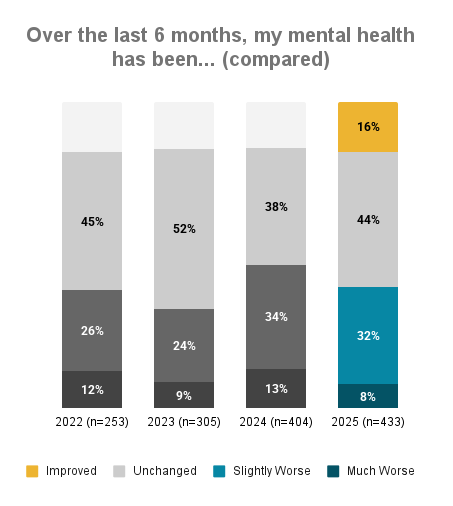
Dads reflected on their mental health over the past six months, with 40% reporting that their mental health had worsened. While this represents a slight improvement from last year, it remains higher than the figures for 2022 and 2023.
It is unsurprising that a majority of dads - 49% - reported the reason for this deterioration as being related to money or work concerns, highlighting the profound impact financial insecurity and employment pressures have on their mental well-being:
“I worry about being there for my children… being able to afford the things I want to provide for them.”
“Stress, workload, feeling responsible yet cannot deliver.”
Dads from Scotland's most deprived areas (SIMD 1) are twice as likely as the overall average to describe their mental health as ‘much worse’ during this period (16% compared to an average of 8%).
Dads who have no contact with their child(ren) reported the poorest mental health with 83% telling us their mental health is ‘poor’ or ‘very poor’.
“I get sadder at not seeing my daughters, and it's hard to get out of that.”
Additionally, almost 1 in 5 dads (17%) whose mental health has deteriorated over the last 6 months has not looked for or received support.
“There is no support for fathers. There are no real groups, GPs have no interest and none of these options apply in real life. The only person I can turn to is my partner and I can't land all my troubles on her. As a father you really do stand alone.”
Previous Reports:
Dads' Survey 2024 Report |
Time with Dad Report |

Background to the Series
The COVID Effect:
Before the Spring 2020 lockdown mothers in couple households in the UK were contributing almost twice as much unpaid childcare as fathers. During the first lockdown we found fathers’ stepping up to do much more hands-on caring of their children - ONS data confirmed what we were seeing - for every hour spent by mum dads were spending 53min. In 2022, as ‘life returned to normal’, we anticipated that dads levels of unpaid childcare would snap back to pre-pandemic proportions. Happily we found this was far from the case, with the ONS once again confirming our survey findings - an 18% increase in fathers unpaid childcare from pre- to post COVID. Lockdown had transformed dads' relationship with their children and sparked a quiet childcare revolution, with more and more fathers wanting to be present and positively involved.
The Impact of a Global Economic Crisis:
As COVID restrictions and regulations eased a global economic crisis was gathering force. The cost of living across the UK began to soar, and in October 2022 inflation hit a 40 year record high of 11.1%. In April 2023 the Scottish Government announced “People all across Scotland are being affected by the most severe economic crisis in a generation”. Our 2023 survey showed that despite the crisis dads were continuing to put their family first, as time spent caring for their children reached a new high. However, dads also told us how difficult they were finding striking a balance between being a provider and caring for their children and the importance of family-friendly work.
For more information about our survey and findings, please contact our director, Cathy Sexton: [email protected]